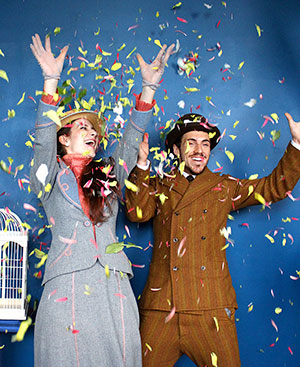
 Left – Margaux Harris & Tim Cole
Something Natural But Very Childish is the first production by the Sydney Independent Theatre Company in their new role as resident company of the Old Fitz in Woolloomooloo. As far as debuts go, this is a very, very good one. This is an intriguing and absorbing show, engaging with questions of love and domesticity in a sophisticated and thoughtful way.
While the title is a (deliberate) misquotation from Coleridge, Something Natural But Very Childish is adapted by Gary Abrahams from short stories by Katherine Mansfield. Mansfield was writing at the fin-de-siecle, and this production retains the Edwardian setting. This is a time period where British culture was emerging (or thought itself to be emerging, per Foucault) from extreme emotional and sexual repression. It is also a time period where the idea of marrying for love was relatively new, making it a poignant setting for exploring questions of love, domesticity, passion, and transgression.
In this show, three separate stories are interwoven, relating thematically although their narratives cross only tangentially. Mansfield was a modernist writer, and I think this adaptation pays some homage to that through its rejection of typical theatrical structure. In the first story, starry-eyed youngsters Henry (Kieran Foster) and Edna (Leah Donovan) fall in love during a chance encounter on a train and dream of a wonderful domestic future together, despite Edna’s assertion that she is a fatalist. In the second, adventurous Anne (Margaux Harris) laughs off the advances of the earnest Reggie (Tim Cole). And in the third, Mrs Bullen (Carla Nirella, in a marvellously nuanced and subtle performance) is unhappily married to Mr Bullen (David Jeffrey), managing to escape from her domestic nightmare only through her singing lessons with Mr Peacock (Michael Faustmann).
There is one piece of the set which I think encapsulates the show perfectly: a birdcage sitting on a table. A plant is growing inside it, branches escaping through the cage bars, reaching up to the sky in a struggle to escape. There is a real tension between love and domesticity in this show, especially for the female characters. For all three, the domestic is a cage – the enemy of real passion, real desire. Love and longing have a kind of poetry, but as soon as they are domesticated, they become prosaic and disappointing. For Edna, this means she avoids taking her relationship with Henry to its inevitable end, choosing to prolong the period in which they are longing to be together. Anne refuses Reggie’s marriage proposal, choosing to wait for a man who excites her and doesn’t make her want to laugh. And Mrs Bullen is trapped in her prison and can experience passion only in stolen moments with her singing teacher – and the more dangerous and transgressive, the more passionate she finds them. For all three, the experience of yearning for a happy ending seems preferable to what comes afterwards: the joy of romance is in the journey, not the conclusion, because in the conclusion, there is the domestic. I won’t spoil it here, but this idea is variously upheld and subverted in the three stories in a very clever way.
The stories of Henry and Edna and Mr and Mrs Bullen seem to fit together very well – one the story of love beginning, the other of love ending. The story of Anne and Reggie, on the other hand, feels a little tacked on. It wasn’t hard to tell that these three narratives were adapted from three disparate short stories: the adaptation was not as smooth as, for example, Caleb Lewis’s adaptation of Rust and Bone at Griffin Theatre earlier this year. Nonetheless, this is a very engaging production, particularly in the second act. It raises fascinating questions about what happens after the happy ending, and whether falling in love is not infinitely preferable to remaining in love. It does not answer these questions – or, rather, provides different answers to them.
Julie Baz has directed a taut and thoughtful show, and has drawn some fantastic performances from her actors, especially from Carla Nirella, who is a revelation as Mrs Bullen. This is an exciting debut from SITCo in the “New Old Fitz”, as they have taken to calling it, and I’m very interested to see what they will do next.
Sydney Independent Theatre Company presents the Sydney premiere of
Something Natural But Very Childish
written and adapted by Gary Abrahams | based on short stories by Katherine Mansfield
Director Julie Baz
Venue: Old Fitzroy Hotel Theatre
Dates: 30 April - 25 May 2013
Times: 8pm Tues - Sat, 5pm Sun
Bookings: www.sitco.net.au
Sydney Reviews
Something Natural But Very Childish | Sydney Independent Theatre Company
- Details
- Jodi McAlister
Most read Sydney reviews
Dancing at Lughnasa | New Theatre
A gifted embroider of words, Friel combines soft lyricism and hard meaning in his play, a tragical comical historical pastoral on a spree and spoiling for a spirited spar.
Stage Kiss | New Theatre
There’s a palpable playfulness to these performances, disciplined, drilled and delightful. There’s fire, bite and fun and lots of kissing.
The First Murder | Pinchgut Opera
In the care of Pinchgut Opera’s director, Erin Helyard, this music, formulaic as it indeed is in some respects, sprang off the page into an experience rich in emotions.
My Brilliant Career | Sydney Theatre Company
Based on an Australian literature classic, My Brilliant Career is destined to become an Australian theatrical classic.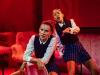
Sistren | Griffin Theatre Company
Iolanthe and Janet Anderson work in cosmic, comedic accord, characterisation charismatic, timing impeccable, delivery precise, together a tour de force that ascends the cliché.
Blind faith and rational belief are always sparring partners in dramatic conflict and so it is here with the power play tinged with superstition and salaciousness.
On the set of a big-budget Hollywood eco-thriller, the clock is ticking for an on time and under budget wrap.